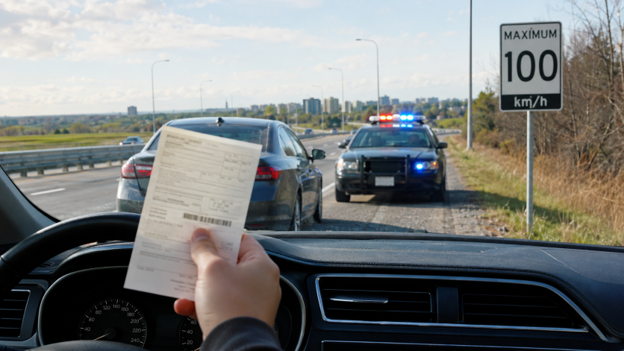
The fine printed on your Ontario speeding ticket is not the full cost. Once you add the victim fine surcharge, court fee, demerit points, and what happens to your car insurance premiums for the next three years, the number on the ticket is often the smallest part of what a speeding conviction costs you.
This guide covers the complete Ontario speeding fine schedule, demerit point consequences, and what your options are before the 15-day response deadline runs out.
Ontario Speeding Fines: The Fine Schedule
Speeding in Ontario is governed by section 128 of the Highway Traffic Act offences framework, specifically prosecuted under the Provincial Offences Act. The fine amount is calculated per kilometre per hour over the posted limit; the further over, the higher the per-km/h rate.
Regular Speeding Fines (HTA Schedule 43)
The following fine schedule is taken from Schedule B to HTA Schedule 43, current as of January 2026. These are the base fine amounts, before the 25% victim fine surcharge and the $5 court fee are added. Demerit point figures are set separately under Ontario Regulation 339/94, not Schedule 43 itself.
| Speed over the posted limit | Fine per km/h (Schedule 43, Sched. B) | Demerit points (O. Reg. 339/94) |
| 1–19 km/h over | $2.50 | 0–3 |
| 20–29 km/h over | $3.75 | 3 |
| 30–49 km/h over | $6.00 | 4 |
| 50 km/h or more over | No out-of-court settlement; court summons | 6 |
Worked example
Caught doing 130 km/h in a 100 km/h zone on Highway 417, that is 30 km/h over the limit. Base fine: 30 × $6.00 = $180. Add the 25% victim fine surcharge ($45) and the $5 court fee: total out-of-pocket before insurance: $230. That is before demerit points, and the insurance rates increase that follows.
Paying the fine is a guilty plea
When you pay an Ontario speeding ticket without disputing it, you are entering a guilty plea under the Provincial Offences Act. Demerit points are applied to your driving record immediately, and your insurer is notified of the conviction.
For speeds of 50 km/h or more over the limit, there is no out-of-court set fine. You will receive a court summons and must appear before a justice of the peace.
Speeding in a Community Safety Zone or Construction Zone
Fines are doubled when the speeding offence occurs in a designated community safety zone (Schedule D) or in a construction zone where workers are present (Schedule F). Speeding in a construction zone without a worker present (Schedule E) carries the same rates as regular speeding. School zone speeding also attracts doubled fines where the zone is designated a community safety zone.
Demerit points remain the same as regular speeding; only the fine amount doubles.
| Speed over the posted limit | Fine per km/h (Schedule D – CSZ) | Demerit points |
| 1–19 km/h over | $5.00 | 0–3 |
| 20–29 km/h over | $7.50 | 3 |
| 30–49 km/h over | $12.00 | 4 |
| 50 km/h or more over | No out-of-court settlement — court summons | 6 |
That same 30 km/h over example costs $360 in base fines in a community safety zone.
Community safety zones in Ottawa are marked by posted signs near schools, parks, and high-pedestrian areas. Doubled fines in designated zones are a frequent surprise for drivers who missed the posted sign.
Beyond the Fine: What a Speeding Conviction Actually Costs
The set fine on the ticket is what gets drivers’ attention. The actual long-term cost of a speeding conviction is the insurance premium increase that follows.
Demerit Points and Licence Suspension
Demerit points accumulate on your Ontario driving record from the date of conviction and remain visible for two years. Under the demerit point system:
- Fully licensed drivers face a warning letter at 9 points, a mandatory interview at 12 points, and a 30-day licence suspension at 15 demerit points or more
- G1 and G2 drivers (new drivers) face a 30-day suspension at just 9 demerit points, a threshold that a single 16–29 km/h over conviction can push them toward
A single Ontario speeding ticket conviction at 30–49 km/h over adds 4 demerit points at once, affecting your driving privileges immediately. A stunt driving conviction adds 6 demerit points. For a G1 or G2 driver, one speeding conviction can put their licence in immediate jeopardy.
Insurance Premiums After a Speeding Conviction
A speeding conviction stays on your Ontario driving record and remains visible to your insurer for three years from the date of conviction, not the date of the offence.
Insurance companies treat speeding convictions as evidence of risk and adjust premiums accordingly.
- A minor speeding conviction (3 demerit points) can increase your car insurance premiums by 15 to 25 percent.
- A conviction carrying 4 or 6 demerit points (30 km/h or more over the limit) is treated as a major violation and can increase premiums by 50 percent or more.
Accumulated over three years, the insurance increase is often five to ten times the original fine.
That 30 km/h over conviction on Highway 417 that cost $230 in fines can cost $1,500 to $3,000 or more in elevated car insurance over three years. For drivers who already carry convictions on their record, a second conviction can push them into high-risk driver status, which can double or triple premiums.
Stunt Driving: When Speeding Becomes a Separate Charge
Driving 50 km/h or more over the posted speed limit does not produce a standard speeding ticket in Ontario. It triggers a stunt driving charge: a separate and significantly more serious offence under the Highway Traffic Act.
Under the 2021 amendments to the stunt driving provisions, a charge triggers three immediate consequences before any court appearance:
- Your licence is suspended at the roadside for 14 days: a 14-day suspension on the spot
- Your vehicle is impounded immediately for 30 days: a 30-day impoundment before any finding of guilt
- You receive a court summons and must appear before a justice of the peace
The roadside licence suspension and vehicle impoundment happen before a speeding ticket lawyer or any other counsel has had a chance to review your case. Upon conviction, the minimum penalties include a one-year licence suspension, fines up to $10,000, and 6 demerit points.
If the same stop also produces impaired driving charges, you are facing two serious proceedings from a single encounter. Retaining a lawyer immediately after a stunt driving charge is necessary.
Contact a Traffic Ticket Lawyer in Ottawa
You Have 15 Days to Respond
When you receive an Ontario speeding ticket, the certificate of offence states a response deadline. You have 15 days from the date on the ticket to respond. Missing this deadline results in automatic conviction; the same outcome as paying the fine, but without any opportunity to negotiate or dispute the charge.
What Happens If You Pay the Fine
Paying the fine before or after the 15-day deadline treats the matter as resolved. The outcome is the same:
- a guilty plea is entered under the Provincial Offences Act
- demerit points are applied to your driving record
- your insurer is notified
- and the conviction appears on your record for three years.
For drivers with existing demerit points, a G1 or G2 licence, or a previous speeding conviction on their record, paying without disputing can have consequences that far outweigh the fine itself.
What Happens If You Fight the Ticket
Requesting a dispute before the 15-day deadline preserves your options. Under the Provincial Offences Act, you can request a First Attendance meeting: an early resolution opportunity to negotiate with the prosecutor before a trial is scheduled. Many Ontario speeding ticket charges result in a reduced charge or charges withdrawn entirely at this stage, with no court appearance required from you.
A traffic ticket lawyer in Ottawa can attend the Provincial Offences Court at the Ottawa Courthouse, 161 Elgin Street, on your behalf. The lawyer reviews defence grounds, including a technical defect on the certificate, problems with radar or speed measurement evidence, and, in cases where the stop itself was unlawful, Charter rights violations that can result in evidence exclusion.
How Frouhar Law Can Help You Fight a Speeding Ticket
Fighting a speeding ticket is not only about lowering the fine. It is about protecting your licence, your insurance record, and your ability to keep driving without added restrictions. Frouhar Law helps drivers understand the real consequences of a speeding conviction before they decide whether to pay, negotiate, or challenge the ticket.
Our traffic ticket defence team reviews the certificate of offence, officer notes, radar or speed measurement evidence, disclosure, signage, location details, and any procedural issues that may affect the strength of the prosecution’s case. Where there are weaknesses, we use them to pursue the best available outcome.
We Review the Evidence Before You Plead Guilty
Many drivers pay a speeding ticket because the fine looks manageable. The problem is that payment is treated as a guilty plea. Before you make that decision, Frouhar Law reviews the evidence and explains what the conviction may mean for your demerit points, insurance premiums, driving record, and licence status.
A lawyer can identify issues that may not be obvious from the ticket itself, including errors on the certificate, problems with disclosure, weaknesses in speed measurement evidence, or grounds to challenge the stop.
We Deal with the Prosecutor on Your Behalf
Once you dispute the ticket, the matter may proceed to early resolution, First Attendance, or trial. Frouhar Law can communicate with the prosecutor, review possible resolutions, and negotiate where a reduced charge or withdrawal may be available.
For many drivers, this means avoiding the stress of dealing with the court process alone. It also means your position is presented by someone who understands how Provincial Offences Act matters are handled in Ontario.
We Help Protect Your Licence and Insurance Record
The long-term cost of a speeding conviction often comes from insurance increases, not the fine itself. This is especially important for G1 and G2 drivers, commercial drivers, drivers with existing demerit points, and anyone facing a high-speed allegation.
Frouhar Law focuses on outcomes that protect your driving record wherever possible. Depending on the facts, that may mean seeking a withdrawal, negotiating a reduced speed, challenging the officer’s evidence, or taking the matter to trial.
Speak with a Traffic Ticket Lawyer Before You Pay
The earlier you get legal advice, the more options you may have to reduce the consequences of a speeding ticket, protect your record, and avoid pleading guilty without understanding the full cost.
Talk to a Speeding Ticket Lawyer
Tel: 613.238.2000
Frequently Asked Questions
How much is a speeding ticket in Ontario for going 20 km/h over the limit?
Going 20 km/h over the posted speed limit in Ontario puts you in the 20–29 km/h band under HTA Schedule 43. The base fine is $3.75 per km/h, giving a base fine of $75.00. After the 25% victim fine surcharge ($18.75) and the $5 court fee, the total out-of-pocket is approximately $98.75. The conviction also adds 3 demerit points to your driving record.
In a community safety zone, the same offence doubles to $7.50 per km/h, approximately $165 in base fines before surcharges. This is precisely why many drivers choose to fight a speeding ticket: the full cost of a conviction is significantly higher than the fine alone.
Do speeding tickets affect insurance in Ontario?
Yes. A speeding ticket in Ontario that results in a conviction (including where you simply paid the fine) is reported to your insurer. The impact on your car insurance premiums depends on the severity of the offence and your existing driving record.
A minor speeding conviction (3 demerit points) typically increases premiums by 15 to 25 percent for three years. A conviction carrying 4 or more demerit points is treated as a major violation and can increase by 50 percent or more. The real speeding ticket cost in Ontario is often the insurance increase, not the fine itself. Multiple convictions within three years can result in a high-risk driver designation.
Is it worth fighting a speeding ticket in Ottawa?
Yes, particularly where demerit points, an existing record, or a G1/G2 licence are factors. The question is not just whether you can beat the charge; it is whether the cost of retaining a lawyer is less than the long-term cost of a conviction on your insurance.
As an Ottawa traffic ticket lawyer, Frouhar Law offers a free consultation before any retainer is signed. Contact us at 613.238.2000.