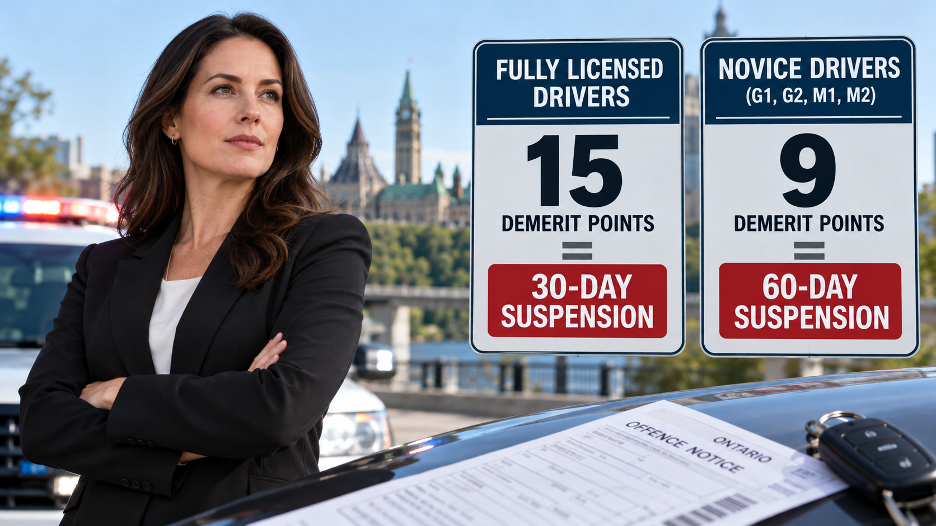
A fully licensed driver in Ontario can hold up to 14 demerit points; the 15th point triggers a 30-day licence suspension. Novice drivers on a G1, G2, M1 or M2 licence reach the same consequence at 9 points, and their suspension lasts 60 days.
This guide sets out:
- how many demerit points you can have
- what each traffic offence adds to your driving record
- how other provinces compare
- what you can do before a ticket becomes a conviction
Frouhar Law represents clients in Ontario only; the other provinces in this guide are covered for comparison.
How the Ontario Demerit Point System Works
The Ontario demerit point system is a record-keeping tool run by the Ministry of Transportation. Points measure your driving behaviour over time. Each conviction for a point-carrying offence adds a fixed number of demerit points to your driver record, and the Ministry acts once your total crosses a threshold.
The demerit point total is not a score you lose. It is a count you build.
Starting at Zero: Convictions, the Offence Date and Two Years
Every driver starts with zero demerit points. A police officer cannot put points on your licence at the roadside; the Ministry of Transportation records them only after a conviction, either because you pay the ticket or because a judge finds you guilty at trial.
Points are dated from the offence date, not the conviction date. They stay active for two years from that offence date and then drop off your total automatically. Ontario Regulation 339/94 calls this running count your “accumulated demerit points”: the points from offences committed within any two-year window.
Knowing your rights at the roadside matters too. Our page on your rights during a traffic stop explains what to say, and what not to say, when an officer pulls you over.
Ontario Regulation 339/94 and the Highway Traffic Act
The Highway Traffic Act creates most point-carrying traffic offences, and Ontario Regulation 339/94 sets the number of demerit points each conviction carries. The Registrar of Motor Vehicles applies that regulation to your driver record.
When a court imposes a licence suspension as part of the sentence, the Registrar generally records no demerit points for that conviction. Hand-held device offences are an exception, and since January 1, 2026, the Safer Roads and Communities Act, 2024 has added stunt driving to that exception.
If you are facing Highway Traffic Act offences, the section number on your ticket tells you which point value applies.
The Maximum Number of Demerit Points by Licence Class
The maximum number of demerit points you can hold depends on your licence class. Ontario sets one scale for fully licensed drivers and a stricter one for novice drivers, and both scales send warning letters before you reach the demerit point threshold for a licence suspension.
Fully Licensed Drivers: 15 Points Means a 30-Day Licence Suspension
Fully licensed drivers with a G licence or full motorcycle licence face this escalation:
- 6 to 8 points: the Ministry of Transportation sends a warning letter.
- 9 to 14 points: you receive a second warning letter about your driving behaviour.
- 15 or more points: your licence is suspended for 30 days.
A 30-day suspension notice gives you a date to surrender your licence at a ServiceOntario centre or by mail to the Driver Control Section. If you fail to surrender your licence, the suspension can stretch to two years.
After the suspension, you may have to redo the vision, written, and road tests and pay a reinstatement fee. Once your licence is reinstated, the Registrar reduces a full licence to 7 points. New points after reinstatement can bring you back for an interview with the Ministry, and reaching the threshold again brings a suspension of six months.
Novice Drivers (G1, G2, M1, M2): 9 Points and 60 Days Off the Road
Novice drivers hold a G1, G2, M1, M2, M1-L or M2-L licence under graduated licensing. A novice driver receives a warning letter at 2 to 5 points, a second warning letter at 6 to 8 points, and a 60-day suspension at 9 points. After reinstatement, the total drops to 4 points.
Novice drivers also face escalating penalties. A single conviction for a Highway Traffic Act offence worth four or more demerit points, such as careless driving or racing, brings a 30-day suspension on a first occurrence, 90 days on a second, and cancellation of the novice licence on a third. In practice, one 30 to 49 km/h speeding conviction can take a G2 driver off the road for 30 days even with a nearly clean driving record.
Too Many Demerit Points? Call an Ottawa Traffic Ticket Lawyer
A conviction is what puts points on your record, so the ticket is the moment to act. Call 613.238.2000 for a free review of your ticket and your current point total.
Talk to a Traffic Ticket Lawyer
Point-Carrying Offences: What Each Conviction Adds
Ontario Regulation 339/94 assigns between 2 and 7 points per conviction.
- Minor infractions such as failing to signal, an improper turn, or a driver seat belt offence carry 2 points.
- Failing to stop at a pedestrian crossing carries 2 points as well.
- Failing to yield, improper passing, and hand-held device use (distracted driving) carry 3 points.
- Following too closely and failing to stop at a pedestrian crossing carry 4 points.
Major infractions carry 6 or 7 points, which means two of them in two years can put a full licence at 12 or more.
Speeding: Demerits by km/h Over the Speed Limit
Speeding convictions are the most common source of demerits in Ontario. The number of points depends on how far over the speed limit the court finds you were driving:
- 1 to 15 km/h over the speed limit: 0 points
- 16 to 29 km/h over: 3 points
- 30 to 49 km/h over: 4 points
- 50 km/h or more over, or 40 km/h or more over where the limit is under 80 km/h: 6 points
The top band also overlaps with stunt driving, which carries roadside licence suspension and vehicle impoundment on top of the points.
Our guide to speeding ticket fines in Ontario covers the dollar side of each band.
Failing to Stop, Passing a School Bus and Leaving a Collision
- Seven points, the highest value in the regulation, attach to two offences: failing to remain at the scene of a collision and failing to stop when signalled by a police officer.
- Six points attach to careless driving, racing, failing to stop for a school bus, and the top speeding bands.
Some serious driving offences carry no demerit points at all. Red-light camera tickets carry no points, because the charge is laid against the vehicle owner. Impaired driving and dangerous driving are Criminal Code offences; a conviction brings a driving prohibition and licence suspension rather than points.
If you face that charge, see our impaired driving defence in Ottawa page.
Fight the Speeding Ticket Before the Points Land
Points attach only on conviction. A review of the evidence before your court date can change what goes on your driving record.
Demerit Point Limits Across Canada
Each province sets its own demerit point limit. Canada has no national scale. Ontario and Alberta both suspend at 15 points for experienced drivers; several Atlantic provinces suspend at 10 or 12.
Points for traffic violations in other provinces can still reach an Ontario driver record, which the next section covers. Ontario also has no defensive driving course that removes points, unlike Nova Scotia and Prince Edward Island.
Alberta, British Columbia (ICBC) and the Prairies
Alberta suspends a fully licensed driver for one month at 15 demerit points within two years, and a new driver in the graduated program at 8 points. British Columbia uses driver penalty points: ICBC charges a penalty point premium once a driver collects more than three points in a year and can suspend at a higher count.
Manitoba ties demerits to insurance through Manitoba Public Insurance’s Driver Safety Rating scale, and Saskatchewan runs a similar sliding scale through SGI. In both, a conviction moves your rating rather than counting toward a fixed suspension.
Quebec (SAAQ), New Brunswick and the Atlantic Provinces
Quebec’s SAAQ suspends an experienced driver at 15 points over two years, with lower limits for learner, probationary and younger drivers; the first suspension lasts at least three months. New Brunswick suspends at 10 points for three months. Nova Scotia suspends at 10 points for six months, Newfoundland and Labrador at 12 points, and Prince Edward Island at 12 points for up to three months.
Demerit Points on Your Driving Record: Checking, Insurance and Your Options
Demerit points on your driving record affect more than suspension risk. They shape your insurance premiums, and convictions from outside Ontario can add to the total. Ontario records points for convictions in other Canadian provinces and territories, the State of New York, and the State of Michigan as if the offence happened here.
Ordering Your Driver Record From ServiceOntario
A traffic ticket does not show its point value, so the driver record is the only reliable way to know how many demerit points you have. ServiceOntario sells two useful products, and insurers often call either one a driver’s abstract:
- a three-year driver record, which lists convictions and suspensions;
- a complete driver record, which also shows your current demerit point total.
You can order either one online, in person, or by mail with your driver’s licence number. Commercial drivers should also check their CVOR record, which tracks carrier points separately.
Why Insurance Companies Rate Convictions, Not Points
Insurance companies in Ontario do not price your policy from the demerit point total. Insurers rate the convictions themselves under rating rules approved by FSRA, the Financial Services Regulatory Authority of Ontario. A conviction with zero points can still raise your insurance rates at renewal. A minor speeding ticket is enough.
That gap is why the cost of defending a ticket often compares well with three years of higher premiums.
Our article on what a lawyer costs in Ontario sets out how fees are structured.
Early Resolution or Trial Under the Provincial Offences Act
Most Highway Traffic Act tickets proceed under the Provincial Offences Act in the Ontario Court of Justice.
You have three options:
- Pay the fine
- Request an early resolution meeting with the prosecutor
- Request a trial.
Paying the ticket means you plead guilty, and the points follow. Our Ottawa traffic ticket defence practice handles both of the other routes.
At trial, the prosecution must prove the offence; our team requests disclosure, tests the officer’s notes and speed-measurement evidence, and raises unreasonable delay under R. v. Jordan where the case has stalled. A paralegal can handle many tickets, and legal advice before your first court date costs nothing at our office; serious charges such as careless driving or stunt driving benefit from a lawyer with trial experience in provincial offences defence.
Protect Your Licence: Book a Free Consultation With Frouhar Law in Ottawa
Frouhar Law offers a free consultation on demerit point tickets in Ottawa, Brockville and Eastern Ontario. Our office at 190 O’Connor Street, Suite 700, takes calls at 613.238.2000, and our Brockville criminal lawyer covers the courts east of the city.