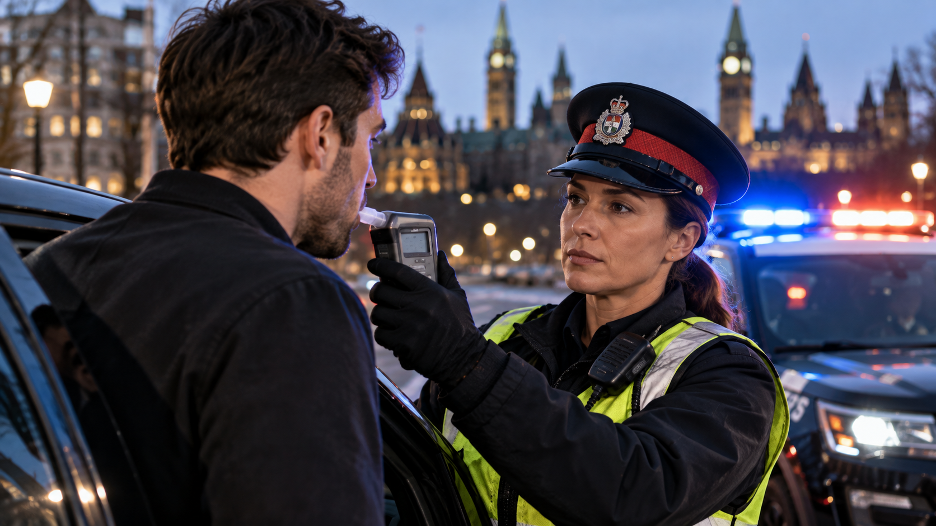
A DUI is the act of driving under the influence: operating a vehicle while alcohol or a drug has impaired your ability to drive, or while your blood alcohol concentration (BAC) is over the legal limit.
In Canada, the Criminal Code does not use the term DUI. The offence is impaired driving, and it is a criminal charge.
A first DUI conviction carries a mandatory minimum $1,000 fine, a driving prohibition of at least one year, and a permanent criminal record. Insurance rates climb. Travel to the United States gets harder. Employment that requires a clean background check can disappear.
This guide explains:
- what counts as a DUI in Canada
- how police build an impaired driving charge
- what the penalties are in Ontario after the 2026 changes
- how a criminal defence lawyer challenges the evidence
What Does DUI Stand For? Driving Under the Influence vs Impaired Operation
DUI stands for driving under the influence. The phrase comes from American statutes and American television, and most Canadians use it in conversation.
Canadian law uses different words. Section 320.14 of the Criminal Code creates the offence of impaired operation of a conveyance, which most lawyers and judges still call impaired driving.
Whatever name appears on the charge, the Crown prosecutes an impaired driving offence as a federal crime under the Criminal Code of Canada, and the Highway Traffic Act adds provincial licence consequences on top.
DUI vs DWI vs Drunk Driving in Canadian Law
DWI means driving while impaired (or, in some American states, driving while intoxicated). Drunk driving is the everyday phrase. DUIs, DWI charges and drunk driving all point to the same Criminal Code provisions.
One distinction does matter. Some people hear « over 80 » and assume it differs from a DUI. It is one of the impaired driving offences: having a BAC of 80 milligrams of alcohol or more in 100 millilitres of blood within two hours of driving. Police often lay both counts together.
The Four Ways to Commit a DUI in Canada Under Section 320.14
Parliament rewrote the impaired driving offences through Bill C-46, which came into force in December 2018. Its reach was wide. Every DUI offence moved into Part VIII.1 of the Criminal Code. A conveyance now includes a motor vehicle, boats, snowmobiles, off-road vehicles, aircraft and railway equipment.
Section 320.14 sets out four routes to an impaired driving conviction, and the Crown only needs to prove one of them:
- Operating a conveyance while your ability is impaired to any degree by alcohol, a drug or a combination of both.
- Having a BAC of 80 mg or more per 100 mL of blood within two hours of ceasing to operate.
- Having a blood drug concentration at or above the prescribed limit within two hours.
- Having a combined alcohol and drug concentration above the prescribed limits within two hours.
The law also reaches care and control. You can face a DUI charge while parked, sitting in the driver’s seat with the keys, if the Crown proves a realistic risk of danger.
Impaired by Alcohol or a Drug, to Any Degree
The first route needs no breath reading at all. The Crown must prove that alcohol or a drug impaired your ability to operate the vehicle, and courts accept slight impairment as enough. Police evidence of impairment usually includes the odour of alcohol, bloodshot eyes, slurred speech, unsteady balance and the manner of driving.
Impairment by drugs covers cannabis, illegal substances, prescription medications and over-the-counter medications. Possession of cannabis itself raises separate Cannabis Act offences. A lawful prescription is no defence if the medication affected your judgement, coordination or reaction time behind the wheel.
Over 80: The 80 Milligram Blood Alcohol Concentration Limit
The over 80 offence is a numbers case. If an approved instrument records a blood alcohol concentration of 80 milligrams of alcohol in 100 millilitres of blood or higher within two hours of driving, the offence is complete, even if you showed no outward signs of impairment.
Higher readings bring higher fines. The Criminal Code sets a mandatory minimum of $1,500 for a first offence with a BAC from 120 to 159 mg, and $2,000 at 160 mg or more.
Ontario also runs a provincial warning range from 50 to 79 mg, which triggers an immediate roadside licence suspension without any criminal charge. Those provincial matters, like a traffic ticket defence in Ottawa, are fought under different rules.
Drug-Impaired Driving, THC Limits and Refusal Under Section 320.15
Drug-impaired driving follows the same structure. For THC, the active compound in cannabis, a blood level from 2 to under 5 nanograms per millilitre of blood is a summary offence carrying a fine of up to $1,000. At 5 nanograms or more, or 2.5 nanograms combined with a BAC of 50 mg, the penalties match alcohol-impaired driving.
Refusal is its own crime. Section 320.15 makes it an offence to refuse or fail to comply with a lawful breath, blood, oral fluid, or drug recognition demand without a reasonable excuse. A refusal conviction carries a mandatory minimum fine of $2,000, higher than most over 80 convictions.
How Police Investigate an Impaired Driving Charge
Most impaired driving investigations begin at a RIDE checkpoint, a traffic stop or a collision. Police officers in Ottawa, including the Ottawa Police Service and the Ontario Provincial Police, follow the same Criminal Code demand powers, and each step creates evidence a defence lawyer later examines.
The investigation usually moves through three stages:
- a roadside screening test
- an arrest if the driver fails
- evidentiary testing at the station
If you are released afterwards, police typically give you a court date.
Some drivers are held for a bail hearing, a process explained in our guide to how bail works in Canada.
Mandatory Alcohol Screening and the Approved Screening Device
Mandatory alcohol screening under section 320.27 of the Criminal Code allows a peace officer who has lawfully stopped a driver to demand a breath sample into an approved screening device, with no suspicion of drinking required. Before 2018, police needed reasonable suspicion of alcohol in the body. That threshold is gone for alcohol.
Drug screening still requires reasonable suspicion. An officer who suspects drug use can demand an oral fluid sample or a Standardized Field Sobriety Test at the roadside. A « fail » on the approved screening device gives the officer reasonable grounds to arrest you and make a further demand.
The Station Breathalyzer: Intoxilyzer and Your Right to Counsel
At the station, the testing becomes formal. A qualified technician takes two breath samples on an approved instrument. In Ontario, that machine is usually the Intoxilyzer 8000C, the breathalyzer whose readings become the evidence in an over 80 prosecution. If drugs are suspected, a Drug Recognition Evaluation by a trained officer and a blood sample may follow.
Your Charter rights apply here. Section 10(b) of the Charter guarantees your right to counsel once you are arrested or detained, and police must give you a reasonable opportunity to speak with a lawyer before the evidentiary breath tests. The roadside screening demand works differently: courts allow police to take that sample before you consult a lawyer.
You can call duty counsel for free legal advice, or ask for a specific criminal defence lawyer by name.
Speak With an Ottawa Criminal Defence Lawyer Before Your First Court Date
The evidence in a DUI case is gathered in the first few hours. Call 613.238.2000 for a free consultation about your charge.
Penalties for a DUI Conviction in Ontario
A DUI in Ontario triggers two sets of consequences.
- The Criminal Code sets the sentence a judge imposes after a conviction.
- The Highway Traffic Act, administered by the Ministry of Transportation, adds licence penalties, some of which start at the roadside before any court appearance.
Impaired driving causing bodily harm carries up to 14 years in prison. Impaired driving causing death carries up to life imprisonment and, under Ontario’s 2026 rules, a lifetime licence suspension.
Fatal cases can also lead to related charges such as criminal negligence causing death.
Criminal Code Mandatory Minimum Fines and Driving Prohibition
Section 320.19 of the Criminal Code sets the mandatory minimum penalties. A judge cannot go below them, whatever your record or circumstances:
- First offence: a $1,000 fine, rising to $1,500 or $2,000 for high BAC readings and $2,000 for refusal.
- Second offence: 30 days in jail.
- Third or subsequent offence: 120 days in jail.
Every conviction also brings a driving prohibition across Canada: one to three years for a first offence, two to ten years for a second, and at least three years after that. A court can allow earlier driving with an ignition interlock device. Repeat offenders face longer prohibitions and mandatory imprisonment.
Highway Traffic Act: Licence Suspension, Ignition Interlock and Back on Track
The Highway Traffic Act moves faster than the courts. A failed screening test, a reading over 80, or a refusal brings an immediate 90-day administrative driver’s licence suspension, a seven-day vehicle impoundment and an administrative penalty. Since January 1, 2026, a first warning range suspension lasts seven days instead of three, and the look-back period for repeat warning range suspensions doubled to ten years.
After a conviction, Ontario adds a licence suspension of at least one year and the Back on Track remedial education program. For offences committed on or after July 1, 2026, Ontario makes the Ignition Interlock Program mandatory for every criminal impaired driving conviction, followed by a minimum six-month zero tolerance condition: no alcohol and no drugs while driving.
Novice drivers, drivers 21 and under, and commercial drivers already face zero tolerance at all times. A Highway Traffic Act offence of this kind can affect your licence long after the criminal case ends.
Criminal Record, Travel to the United States and Insurance Rates
Impaired driving is a hybrid offence: the Crown chooses to proceed by summary conviction, with a maximum of two years less a day, or by indictment, with a maximum of ten years. That ten-year maximum has serious immigration effects. Since 2018, impaired driving counts as serious criminality, so a permanent resident convicted of a DUI can face removal from Canada.
A criminal record follows you to the border. United States officers can deny entry or demand a waiver. Insurance companies treat a conviction as high risk, and some insurers refuse coverage outright. A record suspension from the Parole Board of Canada becomes available five years after the sentence ends for a summary conviction, or ten years for an indictment.
Protect Your Licence and Criminal Record: Schedule a Free Consultation
A conviction is not automatic, and the Crown must prove every element. Our team reviews your case with you at no cost.
How a Criminal Defence Lawyer Defends DUI Charges in Ottawa
DUI charges in Ottawa are prosecuted in the Ontario Court of Justice at the Ottawa Courthouse, 161 Elgin Street, and the defence begins long before trial. At Frouhar Law, Connie D’Angelo leads our impaired driving defence. She has practised exclusively criminal law since 1993 and is a member of the American DUI Defense Lawyers Association, with specialized training in breathalyzer and field sobriety challenges.
Founding partner Mash Frouhar is a former Assistant Crown Attorney who knows how the prosecution builds an impaired driving file.
Our DUI lawyers in Ottawa also appear across Eastern Ontario, including DUI defence in Brockville. Legal fees depend on the complexity of the file; our guide to what a criminal lawyer costs in Ontario explains the factors.
Crown Disclosure and the Breath Test Evidence
The Crown must give you full disclosure of its evidence. In a DUI case, that file usually includes police notes, in-car and booking video, the Intoxilyzer test records, maintenance logs, and the qualified technician’s certificate. We review each document for gaps.
Errors in that evidence are common. Typical issues include:
- an approved screening device used outside its calibration period
- samples taken outside the two-hour window
- an observation period that was not respected
- notes that contradict the video
Each error can weaken the Crown’s case on the over 80 count or the impairment count.
Charter Applications and Procedural Errors
Many DUI defences turn on the Charter of Rights and Freedoms. Police must have lawful grounds for the stop and the arrest (sections 8 and 9), and they must honour your right to counsel (section 10(b)). When police breach those rights, a judge can exclude the breath readings under section 24(2), and the over 80 charge can collapse.
Delay is another ground. Under R. v. Jordan, a case in the Ontario Court of Justice should reach a verdict within 18 months, and our Charter motions practice files stay applications when that ceiling is passed. Our objective in every file is a withdrawal, an acquittal, or the most favourable resolution available, never a guaranteed outcome.
Facing a DUI Charge? Talk With Frouhar Law Today
Free initial consultation, Ottawa, Brockville and Eastern Ontario. Call 613.238.2000 and speak with a lawyer about your impaired driving charge.
This article provides general legal information about DUI law in Canada and is not legal advice; no lawyer-client relationship exists without a signed retainer.